Desert routes around Dubai have become part of the tourist ecosystem: accessible roads, a high density of rental points, and stable demand make desert trips predictable — as long as travelers understand the rules in advance. For tourists or new residents, the risk is not the road itself, but incorrect decisions: choosing the wrong vehicle, ignoring safety protocols, or lacking off-road insurance. Cars rented “blindly” often become a source of unexpected operational expenses.
Why is the desert safari in a rental car becoming increasingly popular?
For most users, renting a car is a tool of control. Tourists and new residents gain access to locations unreachable by public transport and save time. Desert trips are part of this scenario, as the drive takes 40–60 minutes and does not require specialized skills if the route is planned ahead. Key motivations include:
- minimizing dependencies: having your own car removes the need for group tours;
- cost efficiency: renting a car is often cheaper than private tours;
- flexibility: you can visit Al Qudra, Lahbab, Fossil Rock, and other popular spots.

What risks exist when driving into the desert on your own?
The main risk is not the desert itself, but uncertainty. Most incidents reported by RentDrive.ae customers were related to three factors: transmission overheating, refusal to deflate tires, and attempts to drive into deep sand with an unsuitable vehicle. These mistakes lead to:
- additional expenses (recovery can cost 400–800 AED);
- suspension and underbody damage;
- insurance becomes invalid if driving occurs outside the permitted zone.
Is any rental car suitable for the desert?
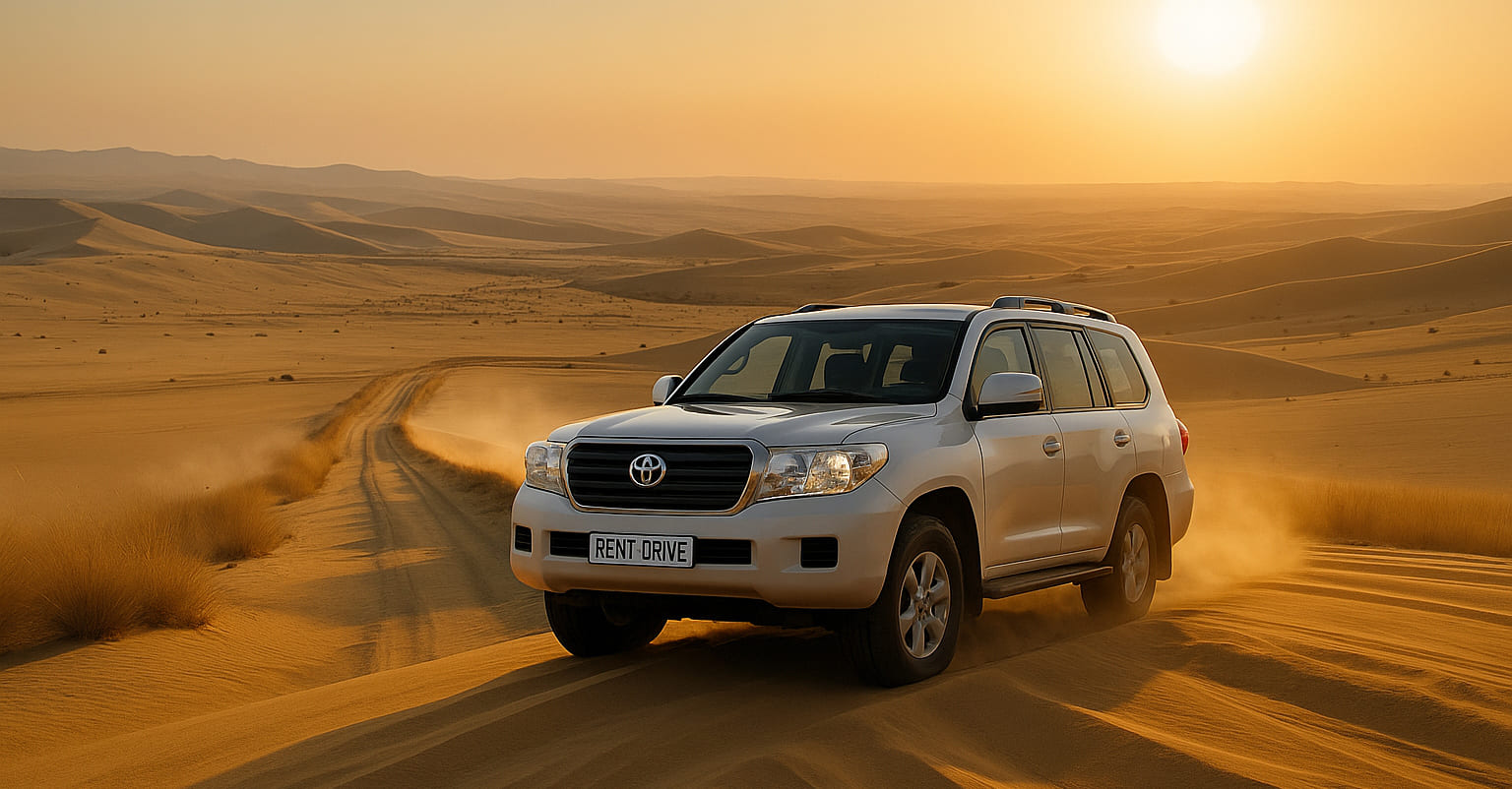
The short answer is — no. Most city cars are designed for asphalt. Off-road driving requires torque, ground clearance, and traction distribution. The most appropriate configuration is an SUV equipped with Sand mode, 4WD, and the ability to disable stability control.
Comparison table by vehicle type
| Vehicle Type | Desert Capability | Risks | Beginner-Friendly |
|---|---|---|---|
| Sedan (Camry, Sonata) | Only asphalt access to entry point | high risk of getting stuck | no |
| Crossover (RAV4, Tucson) | light sandy sections | transmission overheating | partially |
| True SUV (Patrol, Land Cruiser) | full off-road ability | minimal | yes |
| Pickups (Hilux) | stable in sand | requires experience | partially |
What rules are mandatory when going to the desert in a rental car?
- Reduce tire pressure to 15–20 psi.
- Disable traction control when entering the sand.
- Drive in a convoy or at least with a second vehicle.
- Review the route in advance via Google Maps and off-road community forums.
- Reinflate tires on exit using a compressor.
What is strictly prohibited during a desert safari?
- Driving into deep dunes without preparation and proper equipment.
- Ignoring transmission temperature warnings.
- Assuming insurance covers any off-road risk.
- Leaving the car in the desert overnight without communication.
- Driving on unsuitable tires or with low fuel.
Which areas around Dubai are considered safe for first-time trips?
- Al Qudra — firm sand, stable terrain;
- Lahbab (Red Dune) — classic beginner route;
- Al Badayer — easy access but requires an SUV;
- Fossil Rock — more challenging, suitable for those who have practiced.
Sample cost breakdown
| Item | Average Cost in Dubai |
|---|---|
| SUV Rental (RentDrive.ae) | 160–320 AED/day |
| Fuel (50–80 km trip) | 25–35 AED |
| Air Compressor | usually included |
| Desert Recovery | 400–800 AED |
| Replacement of a damaged tire | 150–350 AED |
Why does renting a car from RentDrive.ae reduce desert-trip risks?
Customer behavior patterns show that uncertainty arises when someone faces both the desert and the UAE car market for the first time. RentDrive.ae structures the process to eliminate the variables that typically cause problems.
- Transparent conditions — route limitations are clearly stated in advance.
- Technical standard — vehicles undergo service every 5–7k km, which is critical for SUV transmissions.
- 24/7 support — tourists often lack local recovery contacts.
- Verified vehicles — customers receive cars suitable for light-desert conditions.
- Real consultation — the company will not allow a customer to enter deep desert in an unsuitable model.
Can a beginner go to the desert without guidance?
Technically — yes. Practically — it requires a basic understanding of sand dynamics. For clients renting a car in the UAE for the first time, the instructions must be pragmatic: driving on compacted routes is safe, but any deviation increases risk. The operational algorithm should be standardized:
- checking tire pressure;
- selecting the correct transmission mode;
- avoiding sharp steering inputs;
- constant monitoring of transmission temperature.
When should you choose a guided safari instead of going alone?
Final decision: who is an independent desert safari suitable for, and how does car rental make it accessible?
For tourists and new residents, an independent trip to the desert expands the possibilities of car rental. Route control, independence from group schedules, and budget savings are the main drivers of demand. However, understanding vehicle limitations and route discipline remains critical. RentDrive.ae provides users with the infrastructure that minimizes risks and makes trips predictable: technical support, properly equipped vehicles, and simple rules of use.